
2. Time Alone Isn’t Enough: The Science of Under-Rendered Collagen
Collagen is a structural protein that, when cooked, breaks down into gelatin. However, this process takes time and the right conditions. If your chuck roast is still tough after two hours, it’s likely because the collagen hasn’t fully broken down.
Cooking at too high a temperature can lead to the exterior cooking too quickly, while the inside remains tough. Conversely, cooking at too low a temperature might prolong the cooking time unnecessarily. The key is finding the right balance to ensure the collagen transforms into gelatin, which provides a tender texture.
3. Low and Slow: The Temperature Sweet Spot for Tender Beef
Cooking a chuck roast ‘low and slow’ is the mantra for achieving tenderness. Ideally, the roast should be cooked at a temperature between 275°F and 325°F. This range allows the collagen to break down slowly, turning into gelatin, which is crucial for a tender roast.
Cooking at this temperature range ensures even cooking and prevents the roast from drying out. If you’re using a slow cooker, setting it on low for 7-8 hours is often recommended. For oven cooking, maintaining a steady temperature and checking periodically can lead to the best results.
4. Why Two Hours Almost Never Cuts It for Chuck Roast
Two hours is generally not enough time to adequately break down the tough fibers in a chuck roast. Most recipes recommend cooking a chuck roast for at least 3 to 4 hours, and sometimes even longer, depending on the size of the roast and the cooking method.
This extended time is necessary for the heat to penetrate the roast and allow the collagen to fully render out. Rushing this process can lead to a roast that’s cooked on the outside but still tough on the inside.
5. Stovetop Simmer vs. Oven Braise vs. Slow Cooker: What Actually Works
Each method of cooking a chuck roast has its pros and cons. Simmering on the stovetop can work, but it requires more attention to ensure the liquid level remains adequate and the temperature doesn’t get too high.
Braising in the oven can provide a more even cooking environment, as the enclosed space helps maintain constant heat. Slow cookers, on the other hand, are excellent for set-it-and-forget-it cooking, steadily cooking the meat over several hours to ensure tenderness.
Choosing the right method often depends on your available time and kitchen equipment, but all can produce a tender roast if done correctly.
6. How to Tell If Your Roast Is Undercooked, Overcooked, or Just Right
Determining the doneness of your chuck roast can be tricky. An undercooked roast will feel tough and chewy, as the collagen hasn’t fully broken down. An overcooked roast might fall apart but will be dry and lack flavor.
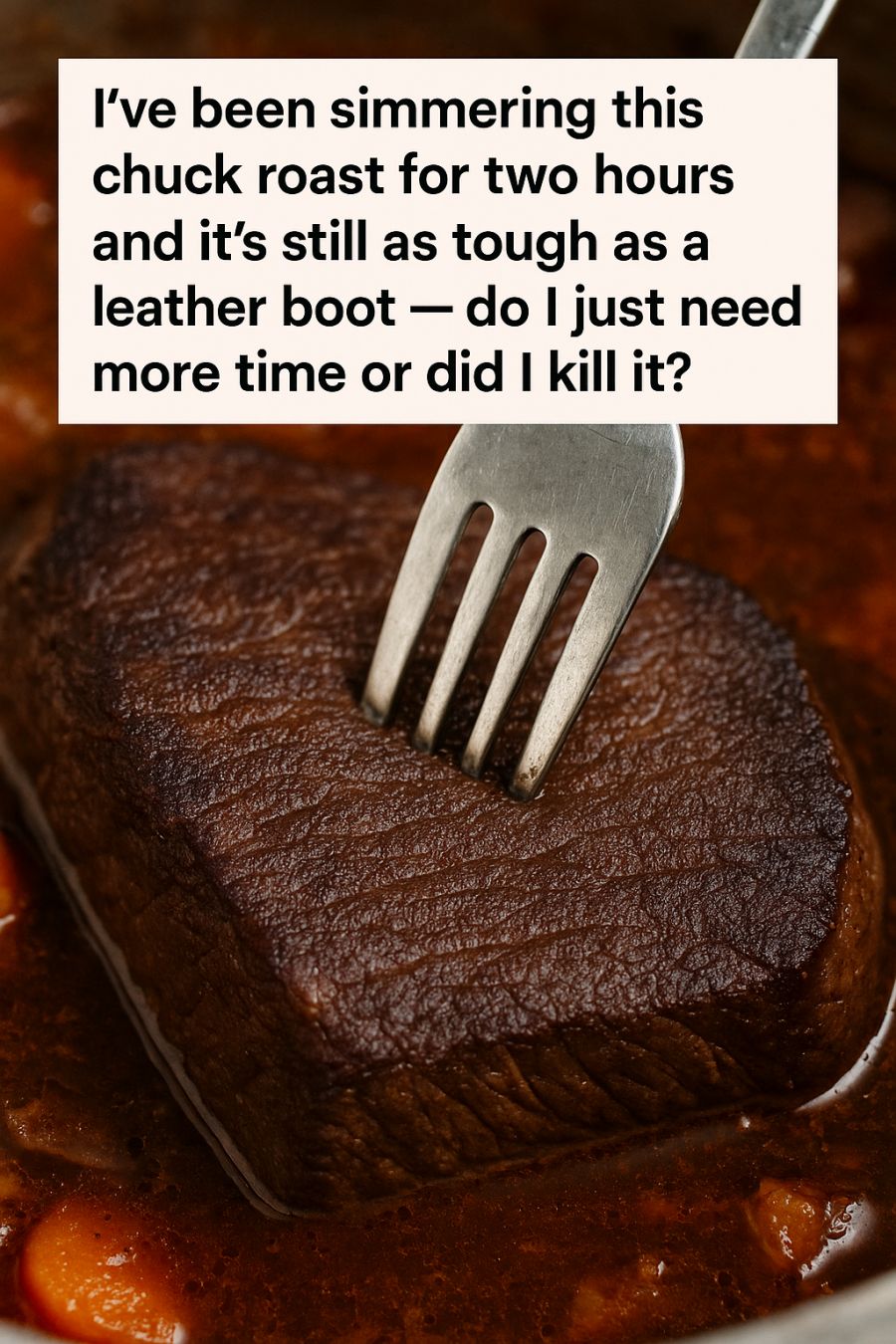
The ideal chuck roast should be fork-tender, meaning it can be easily pulled apart with a fork. If the roast doesn’t fall apart with gentle pressure, it likely needs more time. Conversely, if it’s falling apart too easily and feels dry, it may have cooked too long.
7. The Fork Test, Probe Thermometers, and Other Doneness Clues
The fork test is a simple way to check for tenderness. Insert a fork into the roast and twist; if it turns easily, the roast is done. A probe thermometer can also be useful in ensuring the internal temperature has reached the desired level, typically around 190°F to 205°F for a chuck roast.
Other clues include the roast’s appearance and aroma. A properly cooked roast will have a rich, savory aroma and a deep, even color. If the roast doesn’t meet these criteria, it may need more time.
For Complete Cooking STEPS Please Head On Over To Next Page Or Open button (>) and don’t forget to SHARE with your Facebook friends
ADVERTISEMENT
