
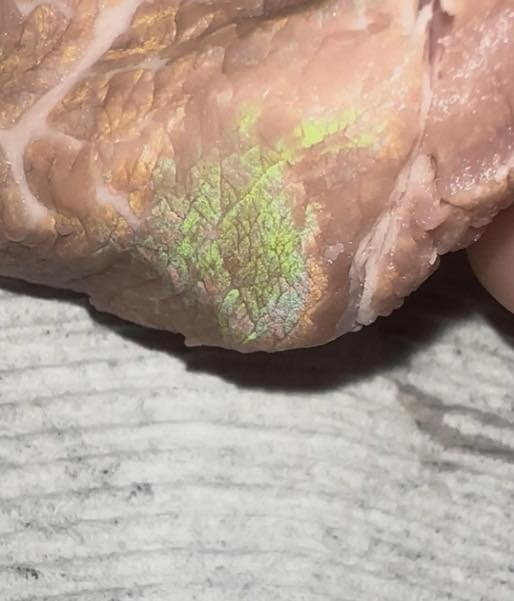
Not all meats shimmer—but you’ll commonly see iridescence in:
Roast beef (most frequent—due to its dense, uniform fiber structure)
Corned beef
Pastrami
Lean, cooked deli meats with visible grain
You’re less likely to see it in:
Ground meats (fibers are broken up)
Fatty cuts (fat scatters light randomly, masking iridescence)
Raw meat (fibers aren’t as rigid or aligned)
📌 Fun fact: The effect is strongest under bright, direct lighting—like LED kitchen lights or sunlight. Dim lighting? You might miss it entirely.
🚫 When Rainbow Meat IS a Problem (Rare—but Important!)
While iridescence is almost always safe, there are rare cases where colorful meat signals spoilage. Here’s how to tell the difference:
Safe Iridescence
Spoilage Warning Signs
✅ Shimmer changes with viewing angle (like a CD)
❌ Dull, consistent green, gray, or black tint
✅ Only on surface of cooked/cured meat
❌ Slimy or sticky texture
✅ No off odor
❌ Sour, ammonia-like, or “rotten” smell
✅ Firm, normal texture
❌ Excessive liquid, puffiness, or mold
⚠️ Trust your senses: If the meat smells bad, feels slimy, or looks dull and discolored regardless of lighting, toss it.
🥪 Why This Matters for Your Sandwich (and Your Peace of Mind)
Understanding this phenomenon isn’t just trivia—it helps you avoid food waste and eat with confidence. Millions of perfectly good deli meats get thrown out every year simply because people mistake iridescence for spoilage.
So next time your roast beef glows like a disco ball, celebrate the physics, not the fear.
🔬 Bonus: Can You Prevent the Rainbow Effect?
Not really—and you don’t need to! But if it bothers you:
Choose thicker slices (less surface uniformity = less diffraction)
Opt for fattier cuts (fat disrupts the fiber pattern)
Store meat in low-oxygen packaging (vacuum-sealed vs. deli-paper wrapped)
But honestly? Most chefs and food scientists consider it a mark of quality slicing and fresh product.
Final Thought: Nature’s Light Show on Your Lunch Plate
That rainbow glint on your deli meat isn’t a flaw—it’s a tiny, edible demonstration of wave optics happening right in your kitchen. It’s proof that even the most ordinary foods hide extraordinary science beneath the surface.
So go ahead—pile that iridescent roast beef high on your rye, add some sharp cheddar and spicy mustard, and enjoy your sandwich with a side of wonder.
🌟 After all, the best meals feed both the body… and the curiosity.
Love food science made simple? Discover why avocados turn brown, why onions make you cry, or how to tell if eggs are fresh—without cracking them!
ADVERTISEMENT
