
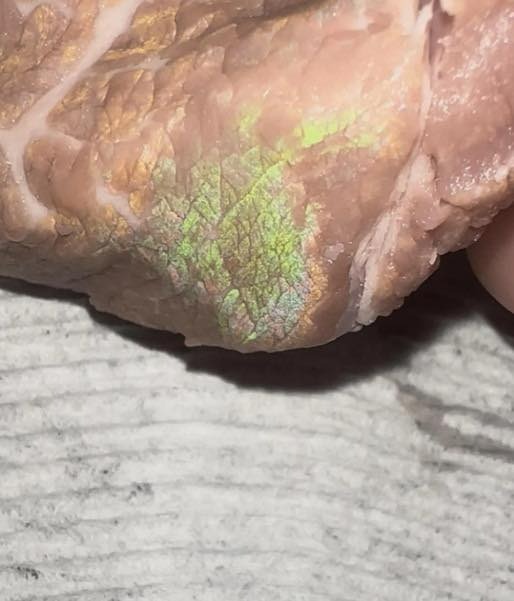
🚫 Don’t eat deli meat if you notice:
Slimy or sticky texture
Sour, rotten, or ammonia-like odor
Gray or green discoloration (not shiny)
Excessive gas in packaging (bulging)
These are signs of bacterial growth — not optical illusions.
🥩 Which Meats Show Iridescence Most Often?
Some cuts are more prone to rainbows than others:
Deli turkey, ham, roast beef
Thinly sliced with smooth surfaces — ideal for diffraction
Cooked beef liver
Dense fiber structure enhances the effect
Cured meats like pastrami
High moisture content + slicing method increases shine
Even raw fish and poultry can show mild iridescence — again, not a safety issue.
❌ Debunking the Myths
❌ “Rainbow meat is spoiled”
False — iridescence is physical, not biological
❌ “It’s from artificial dyes or chemicals”
No — happens even in organic, additive-free meats
❌ “Only processed meats do this”
Raw and cooked whole cuts can show it too
❌ “It means the meat was frozen and ruined”
Freezing doesn’t cause rainbows — slicing and light do
Final Thoughts
That rainbow glow on your roast beef isn’t a flaw — it’s a mini science exhibit playing out on your sandwich plate.
Nature, physics, and your deli slicer have teamed up to create something beautiful — and completely harmless.
So next time you see those shimmering hues…
don’t panic.
Appreciate the wonder of light and muscle fiber alignment.
And then take a bite.
Because real food doesn’t need filters.
It just needs understanding — and maybe a really good mustard.
ADVERTISEMENT
