
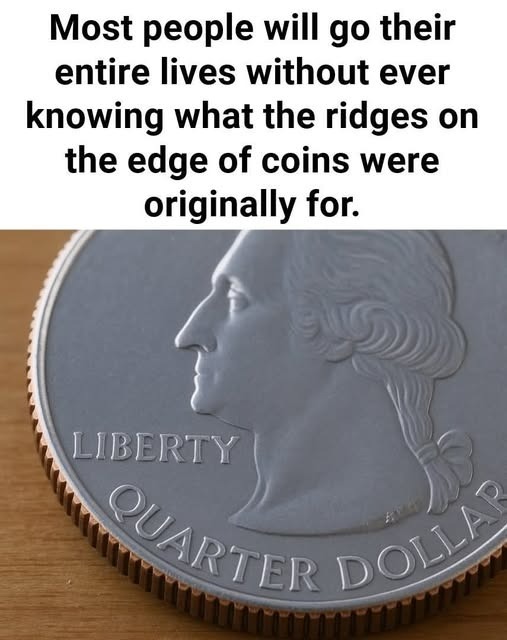
Here’s how it worked:
Coins made from precious metals (like dimes, quarters, and half dollars) had their worth tied directly to the amount of silver or gold they contained.
Clip a few grams off the edge, and you could literally pocket the shavings.
But if the coin had distinctive grooves , any tampering would be obvious.
A clipped ridged coin couldn’t be passed off as full-value anymore.
In short: reeding was early anti-theft tech — an 18th-century security measure that protected the integrity of money long before holograms, watermarks, or EMV chips.
🔍 Why Some Coins Still Have Ridges Today
Even though modern dimes, quarters, and nickels aren’t made of silver anymore (except for collector coins), most still have ridges — and there are good reasons why:
1. ✅ Tactile Identification
Ridges make it easier for visually impaired individuals to tell the difference between coins by touch alone.
A smooth-edged nickel feels different from a ridged dime — even if you can’t see them.
2. 🛡️ Anti-Counterfeiting Feature
While we don’t clip coins anymore, machine-made counterfeits still exist.
Reeding adds another layer of complexity to fake coin production — making it harder for counterfeiters to replicate perfectly.
3. 📜 Historical Tradition
Some features stick around simply because they work — and because they’re part of the coin’s identity.
We keep reeded edges on certain coins today as a nod to tradition , and as a reminder of how far we’ve come in financial security.
🚫 Why Pennies & Nickels Don’t Have Ridges
Ever wonder why pennies and nickels feel smooth around the edges?
There’s a reason.
Back in the day, only high-value coins — those made with silver or gold — were targeted for clipping.
Lower-value coins like pennies and nickels?
Not worth the effort.
They were made of copper and nickel , not precious metals — so there was no incentive to clip them.
Today, the U.S. Mint keeps this tradition alive:
Penny
❌ No
Low-value, not made of silver
Nickel
❌ No
Historically low incentive for clipping
Dime
✅ Yes
Once made of silver
Quarter
✅ Yes
Silver-based until 1965
Half Dollar
✅ Yes
Also once silver-backed
🏦 Modern Uses of Reeding – Beyond Just History
Coin ridges aren’t just historical relics — they still serve practical purposes today.
Vending Machines & ATMs
Many machines use sensors to detect the number and type of coins — and ridged edges help verify authenticity .
Security Design
Like the watermark on paper bills or the hologram on credit cards, reeding is a form of physical security design — hard to copy without proper minting equipment.
Legal Tender Integrity
Coins with intact ridges are more likely to be accepted as legal tender — especially in bulk transactions.
🕰️ From Revolutionary-Era Fraud to Everyday Pocket Change
Think about that next time you get change at a coffee shop or laundry mat.
Every time you feel those ridges on a quarter or dime, you’re touching a bit of history — one shaped by greed, theft, and clever engineering.
What started as a solution to 18th-century fraud has become a staple of American currency — and a quiet lesson in economics, design, and human behavior.
For Complete Cooking STEPS Please Head On Over To Next Page Or Open button (>) and don’t forget to SHARE with your Facebook friends
ADVERTISEMENT
